

3.5 Mastering the social circles
In their search for the ideal sketching locations, the three pupils consulted old acquaintances of Navez, employing this support system to expedite their progress. The widespread use of the French language in Rome certainly worked to the students’ advantage here.1 Although Rome was home to a significant number of foreign artists from all over the (western) world, with Germans being the largest group, the students—being Belgian—were a minority. It is clear, however, that Navez’s students preferred to engage within the predominantly French-speaking circles and showed less interest in their German peers. Whether the three artists approached the latter group and participated in their well-known festivities in the Romana Campagna, such as Cervaro feast, organized by the Società di Ponte Molle, remains unknown. Their reluctance to discuss the German artist community in the correspondence could be seen as an effort to curry favour with their mentor, Navez, who had expressed disapproval of this group during his own journey to Italy.2 Nonetheless, a decade later another student of Navez, Portaels wrote to his parents that he had attended the German festivities.3
Roberti, Storms, and Van Eycken consociated with their fellow French-speaking colleagues in Rome. However, Dutch-speaking Belgians were also part of Navez’s—and thus the students’—social circle.4 For instance, in 1838, the painter from Mechelen, Frans Vervloet (1795-1872), sent his regards to Navez through them. ‘I met Mr. Vervloet there; he sends you his warm regards, as do your other good friends in Rome.’5 Another illustration of the tightness of the Belgian network was when Philippe Jacques Van Brée (1786-1871) and his wife Jeanne Julienne Maupetit arrived in Rome with plans to stay for a few months during winter. Both were welcomed by the Belgian circle with a banquet on December 6, 1838.6 The three pupils happily share the news in separate letters with Navez: ‘Mr. Van Brée arrived in Rome eight days ago, in good health.’7 ‘Mr. Van Brée has arrived in Rome; last Thursday all the Belgian artists in Rome gave a banquet in his honour.’8 [19-20]
Jean-Auguste-Dominique Ingres (1780-1867) was one of these central figures in the French-speaking social circle in Rome, a connection Navez established during his own Italian travels. 9 Ingres then extended his influence with the next generation of artists, particularly Roberti and Van Eycken. In a grateful passage in the correspondence to his mentor, Roberti expressed gratitude for the introduction to Ingres, who provided the students in Rome with access to reproductions and invested in books for the Villa Medici or his personal collection, which the students were permitted to read: ‘I have also benefited from the advice of Mr. Ingres, whom you were kind enough to recommend us to.’10 The students held a profound admiration for Ingres, whose adoration of the Italian Renaissance masters, Rafaël in particular, deeply influenced their artistic outlook. In a letter to Navez, Roberti mentions the popularity of Rafaël among the Belgians in Rome and cites Ingres' own words: ‘In Rafaël, above all, there is nothing artificial; it is pure nature, and, as Mr. Ingres so aptly put it, in his work everything is natural, yet it is nature in its most beautiful and noble form.’11 However, Roberti considered Michelangelo’s work more difficult to grasp.
Beyond the letters of the three students discussed above, maintaining relations through correspondence emerged as a fundamental component of Navez’s strategy for remotely guiding his pupils. This becomes particularly evident in the case of those who spent an extended period in Rome, such as the trio Alexandre Nestor Nicolas Robert (1817-1890), Jean François Portaels (1818-1895) and Jacques Sturm (1808-1844), who all arrived in Rome in 1843. Navez’s transmission of letters to friends in Rome through his pupils highlights the crucial role of written communication in sustaining his circles.
By entrusting his pupils with these letters, Navez likely sought to reduce the practical obstacles and costs of long-distance correspondence, while simultaneously reinforcing the students integration into his social and artistic network. This action served not only as a way to maintain social connections but also granted Navez the ability to carefully steer and manage the flow of information.
Some examples may suffice to illustrate this. Both Victor Schnetz (1787-1870), an old study companion of the studio of Jacques-Louis David (1748-1825), and the Belgian landscape painter Martin Verstappen (1773-1852), also a former study companion of Navez, received his letters via his pupils [21-22]. Verstappen, also known as ‘Bon Papa’ by the students, expressed his pleasure upon receiving one of these letters.
'On the very day your [Navez] letter arrived, we had the pleasure of delivering to Mr. Verstappen [Martin Verstappen (1773-1852)] the one you had addressed to him, together with our own, as per your request. He is now most comfortably settled, residing in a small villa from which he enjoys some of the finest views over the Roman countryside. I thank you once again for the letter that enabled us to make the acquaintance of this most obliging man.'12
'I [Verstappen] received another letter through your three students, who are in excellent health and make good use of their time discovering everything of interest in this capital. Mr. Van Brée assured me that Mr. Van Eycken will become one of the foremost artists. It is a pity that their stay in Rome will not be of long duration.'13
The importance of the figures of Schnetz and Verstappen in the students' daily lives is evident when Navez introduces other students like Charles Coumont (1822-1889) and Joseph Stallaert (1825-1903) to them in anticipation of their arrival in Rome, thus ensuring his pupils would be welcomed in a familiar environment.14 Every Sunday evening, Schnetz, in his capacity of director of the French Academy in Rome (1841-1846 and again from 1853-1866), would welcome the students in gatherings with other artists. Their participation in such meetings provided an ideal opportunity for the students' to boost their confidence and expand their artistic network.

19
Letter J.-B. Van Eycken and J. Storms to F.-J. Navez,
Rome 15 December 1838,
manuscript Cabinet KBR Royal Library of Belgium, inv. no. Ms. II 70/1/358, page 1

20
Letter J.-B. Van Eycken and J. Storms to F.-J. Navez,
Rome 15 December 1838,
manuscript Cabinet KBR Royal Library of Belgium, inv. no. Ms. II 70/1/358, page 2
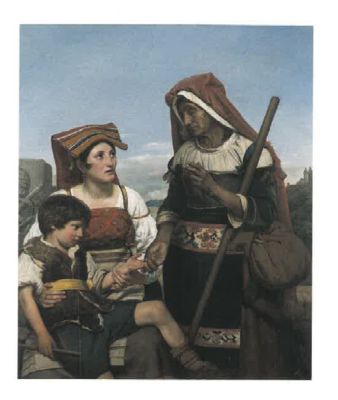
21
Victor Schnetz
The childhood of Sixtus V, dated 1824
Arras (France), Musée des Beaux-Arts d'Arras, inv./cat.nr. D 926 20

22
Martin Verstappen
Mountainous landscape with pilgrims and travelers near a monastery
Paris, Basel (Switzerland), art dealer Galerie Jean-François Heim
Notes
1 Rooryck 2013, pp. 184-200.
2 A. Robert to Fr.-J. Navez, Rome 24 October 1845, Manuscript Cabinet KBR, Ms. II 70/1/187, fol. 341r 242r.
3 F. J. Portaels to his parents, Rome 20 May 1844, Private collection.
4 Coekelberghs/Loze 1985, p. 125.
5 ‘J’y a vu Mr. Vervloet, qui se rappelle à votre beau souvenir. Vos bons amis à Rome font du même.’ J.-B. Van Eycken to F.-J. Navez, Rome 11 February 1839, Manuscript Cabinet KBR, Ms. II 70/1/359, fol. 646r-647r.
6 About Van Brée’s return from Italy, L’Emancipation 10 August 1839.
7 ‘Mr. Van Brée est arrivé à Rome depuis 8 jours en bonne santé.’ A. Roberti to F.-J. Navez, Rome, 15 December 1838, Manuscript Cabinet KBR, Ms. II 70/1/198, fol. 361r -361v.
8 ‘Mr. Van Brée est arrivé à Rome ; jeudi passé tous les artistes Belges en Rome lui ont offert un Banquet.’ J.-B. Van Eycken and J. Storms to F.-J. Navez, Rome 15 December 1838, Manuscript Cabinet KBR, Ms. II 70/1/358, fol. 20r -21r.
9 During his own Italy trip, Navez had expanded his circle of acquaintances to include Jean-Auguste-Dominique Ingres. Later, the two would remain in touch through correspondence. Blanc 1870, pp. 178; Pomarède 2006. KBR Manuscript Department Ms. II 70.
10 ‘J’ai profité aussi des conseils de Mr. Ingres à qui vous avez eu la bonté de nous recommander.’ J.-B. Van Eycken and J. Storms to F.-J. Navez, Rome 15 December 1838, Manuscript Cabinet KBR, Ms. II 70/1/358, fol. 20r -21r.
11 ‘Dans Raphael surtout, rien de guindé; c’est la nature, et, com[me] le dit bien Mr. Ingres […]; chez lui, tout est nature, mais la bel et noble nature’.’ A. Robert to F.-J. Navez, Rome, 15 December 1838, Manuscript Cabinet KBR, Ms. II 70/1/198, fol. 361r -361v.
12 ‘Le jour même où votre lettre est arrivée, nous avons eu le plaisir de remettre à Mr. Verstappen celle que vous lui adressiez, en y joignant la nôtre, selon votre souhait. Il est aujourd’hui très bien installé : il habite une sorte de petite villa d’où il profite des plus belles vues sur la campagne romaine. Je vous remercie encore pour la lettre qui nous a permis de faire la connaissance de cet homme obligeant.’ J.F. Portaels and A.N.N. Robert to F.-J. Navez, Rome 23 December 1843, Manuscript Cabinet KBR, Ms. II 70/1/180, fol. 328r - 329v.
13 ‘J’ai reçu une autre lettre par vos trois élèves les quels sont très bien portant et ne perdent pas leur tem[p]s a voir tous que intéressant dans cette capital. Mons. Van Brée m’a assuré que Mr. Vanijken [Van Eycken] deviendrait un des premiers artistes. C’est dommage que leur séjour de Rome n’en sera pas de long durée.’ M. Verstappen to F.-J. Navez, Rome, 26 December 1838, Manuscript Cabinet KBR, Ms. II 70/1/408.
14 J. Stallaert to F.-J. Navez, Rome 7 May 1848, Manuscript Cabinet KBR, Ms. II 70/1/250, fol. 454r-455v.