

4.3 Beyond the national circle
Despite the closer relationships with other Belgian artists, this 'national circle' was by no means self-contained. Even in their recreational or semi-recreational activities, Belgian artists did not exclude colleagues from other countries, nor were they in their turn excluded from gatherings of artists from other nations. It would be a most rewarding exercise to examine all the names mentioned in Portaels' and Robert's letters, in order to ‘map’ the (inter)national network they were part of. In what follows, some examples of these relations are provided.
In order to establish possible links with the other articles in this publication, the Dutch artists’ community in Rome should be mentioned first. Portaels and Robert, however, do not appear to have been very close with the Dutch artists present in Rome in the 1840s. Their only real Dutch friend seems to have been Pierre-Louis Dubourcq (1815-1873) [11], a painter and lithographer who is mentioned in several of their letters. On a Sunday afternoon in March 1844, for instance, the three of them went to Frascati, in the Roman countryside.1 Portaels and Robert were also acquainted with the Dutch sculptor Jan Antonie van der Ven (1799-1866) [12], who had studied at the academies of Antwerp and Brussels and was quite close to the Belgians in Rome.2
In their letters, other Dutch artists are mentioned here and there, showing how Dutch artists were well connected to the broader community Navez’ pupils were acquainted with. It is amusing to note Portaels’ and Robert’s commentaries, for example, about the brothers Johan Philip Koelman (1818-1893) and Johan Hendrik Koelman (1820-1887). On the 27 of September 1845, Robert wrote to Portaels that the youngest of the Koelman brothers had been married for eight months and even his own brother did not know it.3 In another letter, in 1846, he mentioned a dispute between the brothers: ‘The Koelman brothers are at odds with each other: professional jealousy. They have broken off relations’.4 About Cornelis Kruseman (1797-1857), master to the Koelman brothers and in Italy for the second time from 1841 to 1847, Robert wrote: ‘I have just missed Kruseman. I will tell you all about it, but you should know that he is a beast full of vanity and especially of coarseness’.5
In cases where the ties between Belgian and Dutch artists were less strong, language barriers probably played a part. Whereas Portaels, who was from Vilvoorde near Brussels, spoke Flemish (what he himself called the ‘patois flamand’), Robert only spoke French. Compared to French-speaking Belgian artists in Rome, it was much easier and ‘natural’ for their Flemish counterparts to establish and maintain strong bonds with their Dutch confrères. An example of that is for instance the poem published in 1840 by the Antwerp sculptor and winner of the Prix de Rome Jozef Geefs (1808-1885), entitled Aan de Hoog- en Nederduitsche Kunstvrienden te Roma (to the High- and Low-Dutch art fiends in Rome). One of the verses testifies how sweet it was, when arriving in Rome as a stranger, to be greeted in Flemish (‘Zich 't hooren in het Vlaemsch begroeten’). Although in this specific case, Geefs’ words might have had political connotations as well,6 generally speaking we can say connections between Belgians and Dutch in Rome were indeed important, and probably more so between Flemish/Dutch-speaking artists.7 The publication at issue here is a good starting point for further research to explore these relationships in more depth.
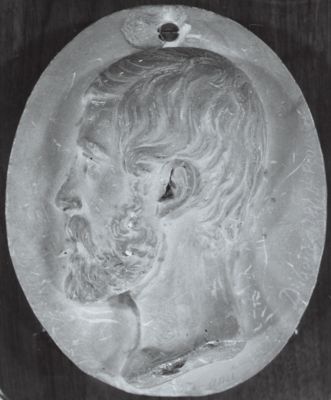
11
Jean-Joseph Tuerlinckx
Portrait of Pierre Louis Dubourcq (1815-1873), 1844 (dated)
Private collection

12
Anonymous c. 1845
Portrait of a sculptor, probably Jan Antonie van der Ven (1799-1866), c. 1845
Amsterdam, Rijksmuseum, inv./cat.nr. SK-A-4193
Notes
1 Letter from Portaels to his parents, Rome, 27 March 1844: Portaels’ correspondence.
2 Portaels’ correspondence. On Van der Ven: Jacobs 1990.
3 Letter from Robert to Portaels, Rome, 27 September 1845: Portaels’ correspondence/AGR.
4 ‘Les frères Koelman sont en bisbrouille: jalousie de métier. Ils se séparent’. Letter from Robert to Portaels, Rome, 24 January 1846: Portaels’ correspondence.
5 ‘Kruseman vient de me manquer. Je te raconterai tout cela, toutefois sache que c'est une bête remplie de vanité et surtout de grossiereté [sic].’ Letter from Robert to Portaels, Rome, 3 April 1846: Portaels’ correspondence. On Kruseman see Geudeker 2024.
6 From the outset, Belgian nationalism was accompanied by a Flemish nationalism, with intellectuals and artists claiming a place for the Flemish language alongside French, which was the official language of government in Belgium. In their pursuit, these intellectuals sought a connection with German cultural nationalism and the Germanic language family. Geefs’ words seem to refer to the cultural ideals of this early ‘Flemish Movement’, which would become a broader political movement from around 1850 onwards.
7 Dupont 2005, p. 329-331. The poem was published in the Flemish journal Kunst- en Letterblad in 1844.