

2.3 Cleomenes’ disciples
Although the art historical discourse from the late 19th century onwards framed Louis Jéhotte and Eugène Simonis as petits maîtres, their impact on 19th-century Belgian art was certainly noticeable. Both men had well-known private workshops that were open to students, and both had teaching positions at the Royal Academy of Fine Arts of Brussels (one of the two main Belgian academies). Jéhotte was appointed a sculpture teacher in 1837. In 1839 he set up a ‘figure antique’ class. The following year, he also became responsible for a course on ‘historical composition’. Jéhotte held this position until 1863, when he was pushed aside after a fierce disagreement. A year earlier, Eugène Simonis had joined the staff with the assignment to teach ‘modelling after nature’, ‘physiognomic drawing’ and ‘historical composition’. He also quickly became the director of the institution as a whole, and occupied that function until 1877.1
The competition between Jéhotte and Simonis (who had the upper hand) could not conceal that both artists shared an aesthetic vision that was highly indebted to classicism and very much inspired by the artistic education and supervision they had enjoyed as young men. Since they left their mark on artistic education themselves – influencing students for four decades – their vision was transferred to the next generations of artists. No less than eleven of Simonis’ pupils travelled to Italy, which can hardly be considered a coincidence.2
One of those young artists was Paul-Joseph Bouré (1823–1848). He left his country in the autumn of 1841 and took up residence in Florence for two and a half years. He rented a studio on the Via dell'Annunziata, close to the studio of Emilio Santarelli (1801-1886).3 This Italian master, a former student of Thorvaldsen, became his mentor. Lorenzo Bartolini (1777–1850), another leading sculptor, recognised the talent and persistence of the young Belgian, and congratulated him on his Lying Young Faun [11].4 Finelli, who had been Simonis’ teacher, was charmed by the Meditating Amor (1844) [12] that he saw in Bouré’s studio. Apart from Bouré’s intelligence and physiognomy, which reminded Finelli of some of Eugène Simonis’ characteristics, the Italian master observed that Bouré was capable of creating artworks in accordance with his feelings and sensitivity.5 Although Meditating Amor’s realism hints at Bartolini’s influence (see, for instance, his Amor from 1841), it conforms with Canova’s aesthetics, established a few decades earlier. Canova’s Winged Cupid (1795) [13] had clearly been a model for Bouré.
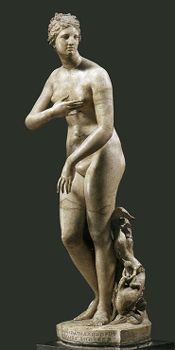
In order to show that the legacy of Canova and Thorvaldsen continued to influence Belgian sculpture production in the second quarter of the 19th century and afterwards, we will take a closer look at a series of sculptures representing Venus or bathers: Bathers by Philippe Parmentier (1823), Louis Jéhotte (before 1834) and Charles-Auguste Fraikin (1842); Mathieu Kessels’ Venus After the Bath (ca. 1826–1829); and Eugène Simonis’ Innocence (1838–1839).6 The selection spans twenty years of sculpture production in the southern Low Countries (Belgium), all reflecting elements of a classical archetype: the Venus Medici by Cleomenes (ca. 100 BC) [14]. Plaster copies and printed reproductions of this Hellenistic masterpiece circulated at the time, and the original marble could be seen at the Uffizi (on display there from 1816).7 With the exception of Philippe Parmentier (1787–1851), about whom hardly any biographical information is available, all of the sculptors mentioned sojourned in Italy, and almost certainly saw theVenus Medici with their own eyes.8 Formal parallels are striking: the contrapposto, the position of the arms, the inclination of the head, the display and concealing of nudity, the psychological disposition of the character dealing with that exposed nudity, etc. The 19th-century creations were the result of an artistic praxis guided essentially by the principles of imitatio and aemulatio. Everything revolved around resuming the classic schemes and trying to bring them to an even higher level by subtle alternations in pose, shape and texture.

11
Paul-Joseph Bouré,
Lying Young Faun, 1843,
cast bronze, 88.5 x 131 x 53 cm,
Royal Museums of Fine Art of Belgium, Brussels, inv. no. 3006

12
Paul-Joseph Bouré,
Meditating Amor, 1842,
plaster, 127 x 85 x 56.5 cm,
Royal Museums of Fine Art of Belgium, Brussels, inv. no. 1071

13
Antonio Canova,
Winged Cupid, 1795,
marble, 42 x 54.5 x 48 cm,
Hermitage Museum, St. Petersburg
14
Anoniem Greece naar Praxiteles
De Medici Venus
Florence, Galleria degli Uffizi, inv./cat.nr. 1914 no. 224

15
Antonio Canova (workshop),
Venus Italica, ca. 1822-1823,
marble, h 175,3 cm,
Metropolitan museum of Art, New York, inv. no. 2003.21.1

16
Berthel Thorvaldsen,
Venus with the Apple [1813-1816], 1828,
marble, h 160,8 cm,
Thorvaldsens Museum, Kopenhagen, inv. no. A 853

17
Philippe Parmentier,
Bather, 1823,
marble, 145 x 40 x 50 cm,
Royal Collections of Belgium

18
Mathieu Kessels,
Venus after the Bath, ca. 1825-1829,
marble, 97 x 43 x 32 cm,
Royal Museums of Fine Art of Belgium, Brussels, inv. no. 10
While it is interesting to compare this set of 19th-century sculptures with a truly classic archetype such as the Venus Medici, it is also worth examining them alongside the work of contemporary artists and their immediate predecessors. Canova’s Venus Italica [15] from 1804 and Thorvaldsen’s Venus with the Apple [16] with its original model from circa 1813–1816 are obvious references. The postures and rigour of both Parmentier’s Bather [17] and Kessels’ Venus After the Bath [18] are quite similar to Thorvaldsen’s Venus. In contrast, Simonis’ Innocence [19] possesses a grace and charm that are more reminiscent of the Canovian school, as evidenced by the frozen moment in time and the manner in which the drapery is carved. On the other hand, Simonis emulated Bartolini’s The Ninfa Arnina (Nymph of the Arno) (1825) [20], of which several copies existed.9

19
Eugène Simonis,
Innocence, 1839,
marble, 142 x 54.5 x 58.5 cm,
Royal Museums of Fine Art of Belgium, Brussels, inv. no. 558.

20
Lorenzo Bartolini,
The Ninfa Arnina (Nymph of the Arno), 1825,
plaster, 148 x42 x75 cm,
Galleria dell’Accademia, Florence, inv. no. sculture 1214
These kinds of intergenerational influences are also noticeable in the ‘Belgian school’. A formal comparison between Innocence and the 1842 Bather [21] by Charles Auguste Fraikin inevitably suggests that Fraikin was familiar with Simonis’ sculpture. Since Innocence was on display at the 1839 exhibition of living masters held in Brussels in 1839, this assumption can probably be taken for granted. Similarly, the Young Woman at the River (1863–1866) [22] by Jacques Jaquet (1828–1899) echoes Louis Jéhotte’s Bather (pre-1834). Although her necklace alludes to a certain ‘savageness’ (as one would have labelled this in the 19th century), which indicates a more romantic intention, the upper bodies of both marble sculptures visually demonstrate their affiliation. In this particular case, a kinship between the artists is documented. From 1843 to 1849, Jaquet studied under Jéhotte at the Brussels Academy.10 It exemplifies how formulas from the early 1800s persisted even in the second half of the century.

21
Charles Auguste Fraikin,
Bather, n.d.
marble, h 40 cm.
Museum Fraikin, Herentals

22
Jacques Jaquet,
Young Woman at the River, ca. 1863-1866,
marble, 135.8 x 61.5 x63 cm,
Royal Museums of Fine Art of Belgium, Brussels, inv. no. 12.070
Notes
1 Ollinger-Zinque 1987, p. 94; Dupont 2005, p. 211; Colman 2010, p. 180-181.
2 Dupont 2005, p. 211-212.
3 Van Soust de Borkenfeldt 1849, p. 7-11.
4 Van Soust de Borkenfeldt 1849, p. 14-15.
5 Van Soust de Borkenfeldt 1849, p. 15-16.
6 Also: Grandesso 2012, p. 229-247.
7 The Uffizi Gallery website: https://www.uffizi.it/en/artworks/medici-venus.
8 Bussers 1990, p. 520-522.
9 Gallery of the Academy of Florence website: https://www.galleriaaccademiafirenze.it/en/artworks/arnina/.
10 Van Lennep 1990b, p. 456.